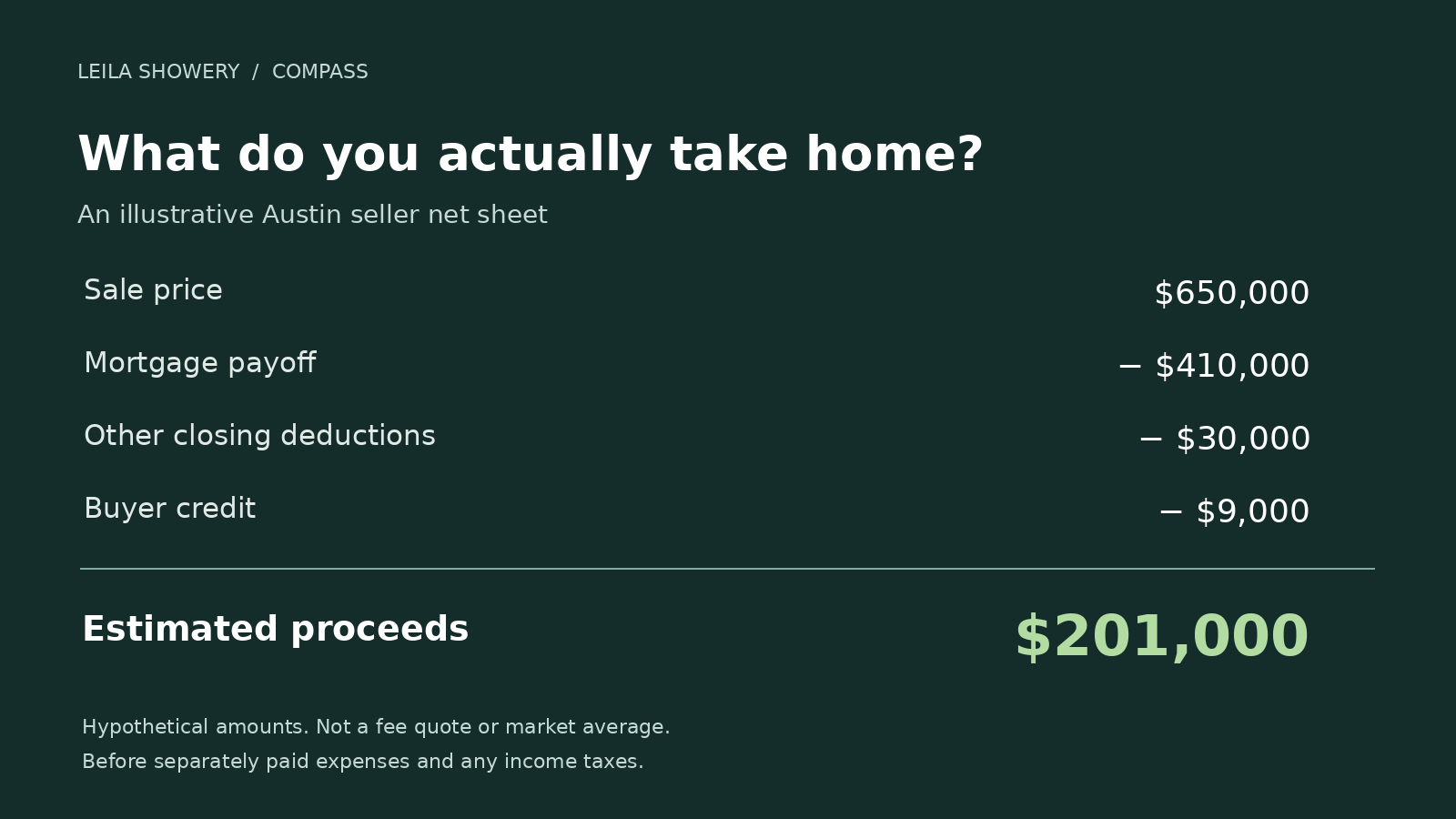
Estimate your net proceeds by subtracting mortgage and other lien payoffs, seller closing costs, prorations and agreed buyer credits from the sale price. Then account for expenses paid outside closing. A useful seller net sheet uses your actual agreements and expected closing date, and gets updated as the terms change.
You can sell a house for a number you like and still walk away with less than you expected. The sale price gets the attention. The amount available for your next move deserves just as much.
I’m Leila Showery, an Austin REALTOR® with Compass. Before you decide what you can spend on the next house, I would start with a seller net sheet and a few realistic sale scenarios.
Is home equity the same as your sale proceeds?
For a rough starting point, people often subtract their mortgage balance from an estimated home value and call the difference their equity. That is useful context, but it does not include everything that comes out of a sale.
Your take-home amount also depends on the agreed price, loan payoff, selling expenses and negotiated terms. Money you spend preparing the home may already have left your bank account before closing. Track that separately so your closing proceeds do not get confused with your overall financial result.
Start with an actual mortgage payoff
The balance in your mortgage app may be different from the amount required to pay off the loan. The Consumer Financial Protection Bureau explains that a payoff includes interest through the payoff date and may include unpaid fees. Request a payoff for the expected closing date, and include a second mortgage or home equity line if you have one. [1]
If your closing date moves, ask title to update the payoff and the rest of the estimate. A worksheet based on last month’s balance can give you the wrong number to plan around.
What else belongs on an Austin seller net sheet?
Ask for a line-by-line estimate rather than relying on one blanket percentage. Use these questions to build it:
- Brokerage compensation: What do your signed agreements require, and does the offer include a contribution toward the buyer’s brokerage compensation? Compensation is negotiable; use your transaction’s actual terms. [2]
- Title and settlement charges: Which policy and fees are you paying? Texas title insurance premiums are regulated, but the parties may negotiate who pays the premium. Other settlement fees can vary, so request an itemized quote. [3]
- Property taxes and other prorations: What amount is assigned to your side for the expected closing date? The TREC resale contract addresses prorations and later adjustments when actual tax statements differ from the closing estimate. Have title explain the calculation for your contract. [2]
- Buyer credits and agreed work: Which concessions are reflected on the closing statement, and which contractor invoices will you pay separately? Keep each expense in one place in your budget.
- Other obligations: Ask title whether additional liens, unpaid charges, association amounts or other property-specific items affect the estimate.
A simple example: selling for $650,000
Here is an invented example to show the math. It is not an estimate of typical Austin fees.
| Item | Illustrative amount |
|---|---|
| Sale price | $650,000 |
| Mortgage and other loan payoffs | −$410,000 |
| All other seller closing costs and prorations | −$30,000 |
| Agreed buyer closing-cost credit | −$9,000 |
| Estimated proceeds at closing | $201,000 |
In this example, the $30,000 bucket includes all remaining seller closing deductions, including the assumed brokerage compensation, title charges and prorations. The separate $9,000 credit is counted once. Any preparation, moving costs or income taxes paid outside closing still need their own place in the overall budget.
Compare offers using the same assumptions
Ask for the estimated net under each offer. Then compare the closing date, financing, contingencies, requested work and possession terms alongside the dollars.
A higher price with a larger credit can produce less money for you than a lower price with fewer deductions. A later closing can also change your payoff and carrying costs. Put both offers on paper using their actual terms before deciding which works best for your move.
If you are buying again, read my guide to selling your Austin home before buying the next one. The amount you expect to receive and the day it becomes available both matter.
What should you ask for before listing?
Request a likely, lower and higher sale-price scenario using the same estimated closing date. Ask which numbers are confirmed and which are allowances. Revisit the worksheet when you receive an offer, agree to repairs or change the closing date.
For your whole moving budget, also track staging, preparation, storage and moving expenses. Ask your tax professional about any income-tax consequences; this proceeds worksheet does not calculate your taxable gain.
Want a clearer starting point? Send me your Austin property address and moving timeline, or email leila.showery@compass.com. We can work through the likely price range and the costs that belong in your estimate before you make plans around the proceeds.
Frequently asked questions
Is my mortgage balance the amount title will pay off?
Not necessarily. A payoff statement accounts for the amount needed to satisfy the loan for a specified date, including applicable interest and fees. Ask for an updated payoff tied to the expected closing date.
Is there one standard percentage for Austin seller closing costs?
Use an itemized estimate for your property and agreements. Brokerage compensation is negotiable, title-policy responsibility depends on the terms, and prorations and other charges depend on the transaction.
Does a seller net sheet include money I already spent preparing the home?
Check the worksheet. Costs paid outside closing may not appear in the proceeds figure. Track preparation and moving expenses separately so you can see the full budget without counting an expense twice.
Sources and local research tools
Sources checked October 29, 2026.